
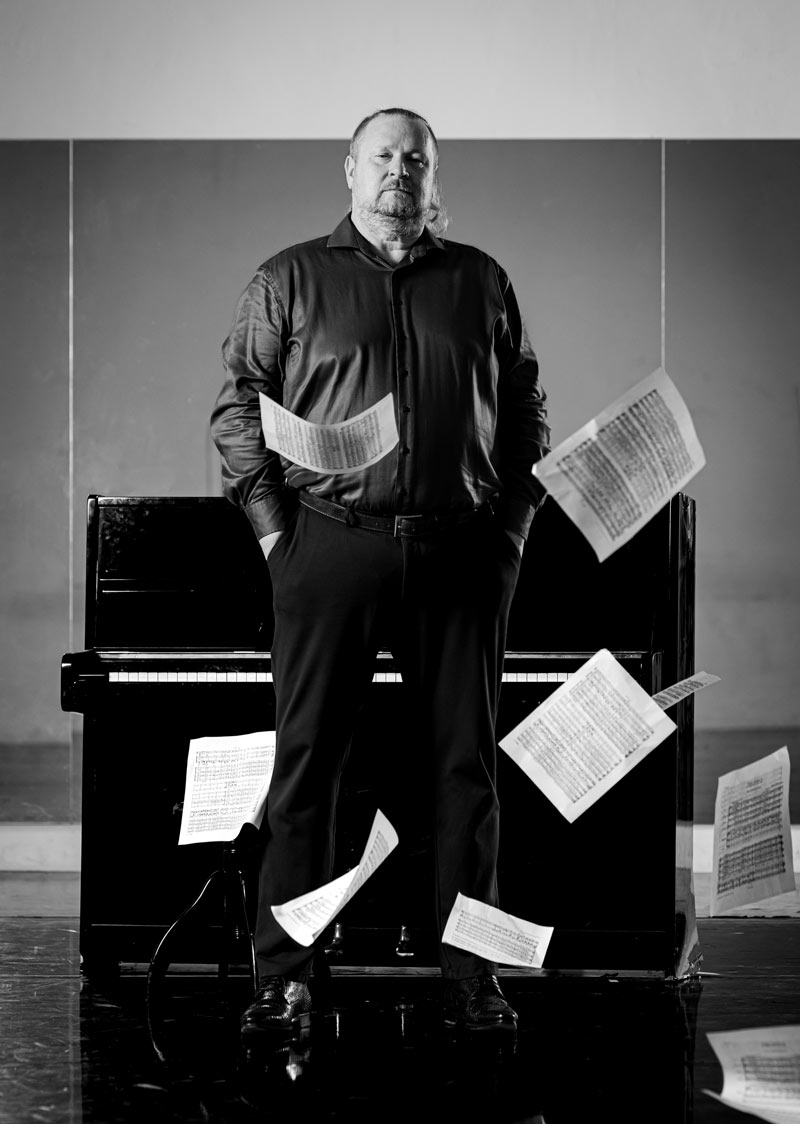
My name is Vladimír Nagy, and I have devoted my entire professional life to law. Alongside it, however, another passion has accompanied me throughout my life – classical music.
I have played the piano since childhood, and in my youth I even tried my hand at composing. I freely admit that a career as a composer was probably not meant for me. My love of music, however, often bordering on obsession, has remained.
My relationship with classical music is far from ordinary, as demonstrated by my particular fondness for Ludwig van Beethoven. I am the proud owner of a lock of his hair, which I successfully acquired at auction and which now has a place of honour above my piano.
From Ludwig van Beethoven, I gradually moved on to studying the lives and works of other great composers. I devoted a part of my life to each of them – reading their correspondence, biographies, scores and the recollections of their contemporaries, exploring the historical context and, naturally, listening to their music.
I wanted to understand not only their works, but also the people who created them.
Franz Liszt, however, came to occupy a very special place in my life.
When I began exploring his music and life in greater depth several years ago, my fascination with this versatile genius never left me. On the contrary, the more I learned about him, the more compelling he became.
Liszt was not merely a brilliant pianist and composer who pushed the boundaries of the music of his time. He was an innovator, a visionary and an artist with an extraordinarily open mind.
At the same time, he was not a self-absorbed genius concerned only with his own success. Liszt played a major role in promoting and establishing wider recognition for many works by his celebrated predecessors. He supported his contemporaries, performed their works, helped young talents and often used his reputation to bring them to the attention of the wider musical world.
He also contributed significantly to the development of many national musical movements in the European countries he visited during his concert tours. Liszt’s greatness therefore lay not only in his talent, but also in his generosity, broad outlook and willingness to help others.
My admiration for Liszt was gradually joined by pride in his roots and his deep connections with Bratislava and the territory of present-day Slovakia. At the same time, one question increasingly troubled me: why do we know so little about this connection?
Why do we not more openly embrace the legacy of a figure who ranks among the greatest personalities of European music and whose life and artistic journey are so closely connected with our cultural space?
My wife once asked me why I kept all my knowledge and enthusiasm to myself. Why did I not transform them into something greater and more meaningful that could also inspire other people?
And that is how the idea of a Franz Liszt festival was born.
Today, that idea is becoming a reality. The festival seeks to symbolically bring Franz Liszt back to Bratislava, recall his connections with our city and present his music in all its power, diversity and timelessness.
My ambition is to combine outstanding artistic performances with a powerful story, introduce classical music to new audiences and build a respected cultural event of Central European significance.
And why did I name the Franz Liszt festival festival3cities? The original concept behind the event is to connect our festival in Bratislava with the Franz Liszt festivals in Raiding, Austria – Liszt’s birthplace – and in Budapest.
These places formed an important part of the world in which Franz Liszt lived, travelled and created. Over time, I would like to introduce the leading performers from our festival to audiences in all three countries.
I believe that the Franz Liszt festival, festival3cities, will become an exceptional event not only for Bratislava, but for Slovakia as a whole.
I am convinced that it will lay the foundations for a new musical tradition, contribute to a deeper understanding of Liszt’s work and help strengthen Bratislava’s position on the musical map of Europe.
Above all, however, I hope that you – the future visitors to the festival – will discover what I discovered years ago: an artist and a human being whose music can still fascinate, surprise and move us deeply almost two centuries later.